Building an AI-Ready Workforce for Enterprise Transformation
AI and analytics only transform an enterprise when people can use them. How to build the data foundation, close the skills gap and measure progress, from my panels at the Middle East Enterprise AI & Analytics Summit in Riyadh.

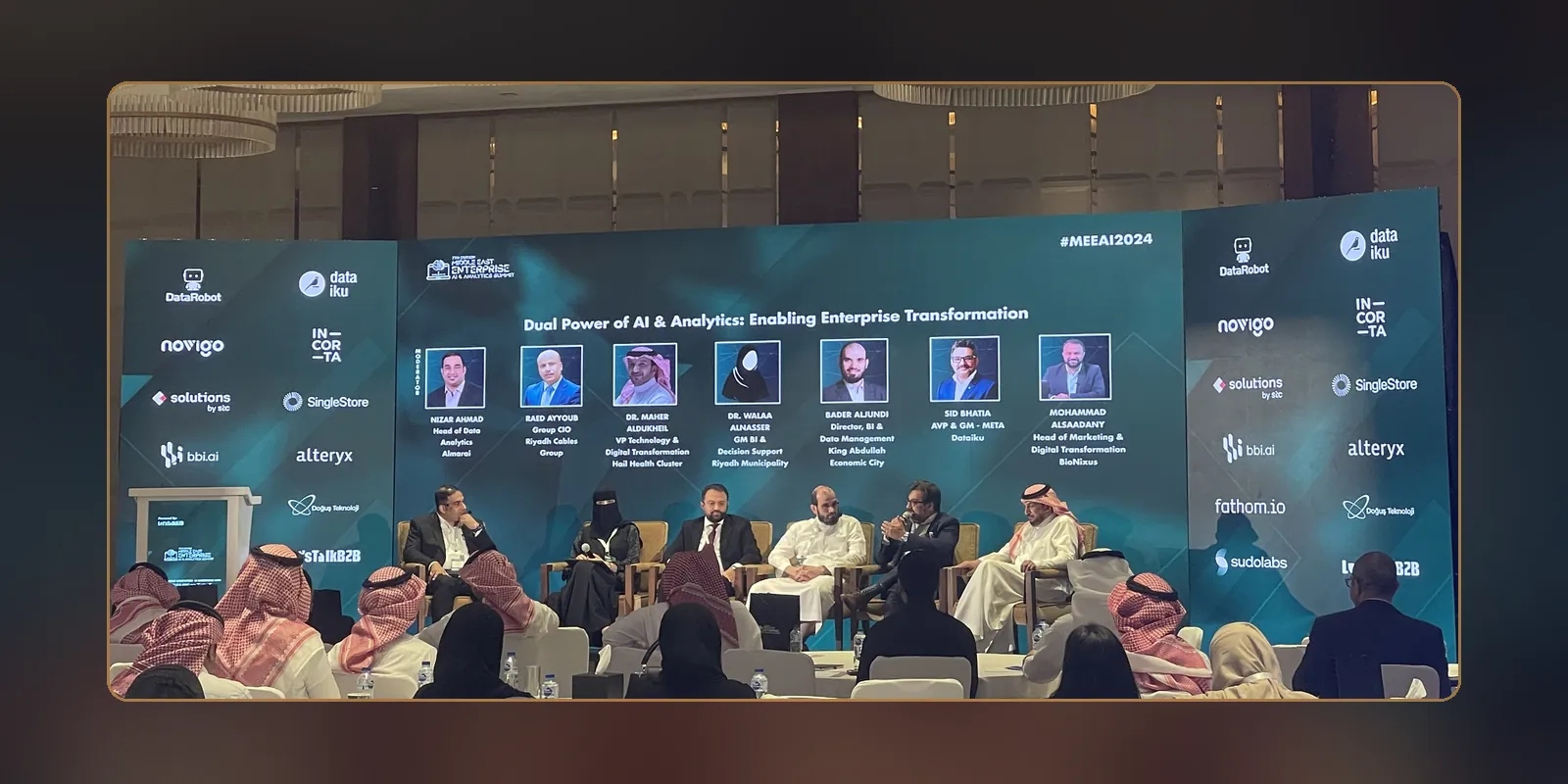
In May 2024 I joined the 7th Middle East Enterprise AI & Analytics Summit in Riyadh as a guest of honour at the opening session, as Al-Ahram reported, and as a speaker on two panels: Bridging the Gap: Building a Futuristic Workforce for Intelligent Enterprises and Dual Power of AI & Analytics: Enabling Enterprise Transformation.
The two topics belong together. In enterprise AI, technology is rarely the bottleneck. People, skills and ways of working usually are. Saudi Arabia's National Strategy for Data and AI has made building these capabilities a national priority, and companies across the region face the same question: how do we get our people ready?
The dual power of AI and analytics
Analytics tells you what happened and why. AI predicts what is likely to happen next and helps you act on it, often automatically. Enterprises get the most value when the two work together:
- Analytics creates a shared, trusted view of the business: customers, operations and finance.
- AI turns that view into forecasts, recommendations and automated actions.
- People decide what to do with them, and improve the system over time.
Skip the analytics foundation and AI gives confident answers built on unreliable data. Skip AI and analytics stays a rear-view mirror.
Start with the data foundation
- One agreed definition for each key metric, used by every department
- Clean, connected data from the systems that matter most, such as CRM and ERP
- A named owner for every important data set
- Governance for privacy and security, in line with rules such as Saudi Arabia's Personal Data Protection Law
Bridging the skills gap
An AI-ready workforce is not a company full of data scientists. It is a company where every role understands how AI changes its work.
1. Map roles and decisions, not just tools
For each function, list the decisions and tasks AI can speed up or improve. In marketing, that means lead scoring, content variations, campaign reporting and customer insight. In finance, forecasting. In operations, demand planning and quality.
2. Build three levels of capability
- Everyone: AI literacy, data basics, and safe, responsible use of AI tools
- Power users: analysts and team leads who build dashboards, prompts and automations for their teams
- Specialists: data engineers, data scientists and AI product owners who build and maintain the core systems
3. Learn on real work
Training sticks when people apply it to their own work within days. Pair short courses with pilots on real business problems, and give every pilot an owner and a clear success measure.
4. Lead the change
Leaders need to explain why AI matters, what will change and what will not, and use the tools themselves. Recognize the teams that adopt them, and retire the old reports and processes the new ones replace.
5. Build, hire or partner
Build what is core to your advantage, hire for the roles you need long term, and partner for the rest. The right local and international partners speed things up, as I explain in how to choose technology partners.
Measure progress
- Adoption: active users of AI and analytics tools, by team
- Time saved: hours freed from repetitive work
- Better decisions: forecast accuracy, response times and conversion rates
- Business results: revenue, cost and customer satisfaction
Review these numbers every quarter, alongside the skills plan, so that people and technology move forward together.
Where marketing fits
Marketing is often the first function where AI pays off, because results are measurable and cycles are short. That makes it a good proving ground for the rest of the enterprise. It is the work I do in AI marketing and automation and in healthcare and pharma marketing leadership.